


How Does A High Barrier Bottle Blow Molding Machine Work
A high barrier bottle blow molding machine produces multilayer containers for pesticides, chemicals, and other sensitive contents. Instead of relying on one resin, it combines materials with different functions. Kingplas configures these systems around the bottle design, barrier requirement, resin combination, and expected production output.
Layer Design Solves A Material Problem:
A single plastic material may provide good strength but limited resistance to oxygen, vapor, or chemical permeation. A multilayer blow molding machine addresses this issue by combining structural and barrier materials in one bottle wall.
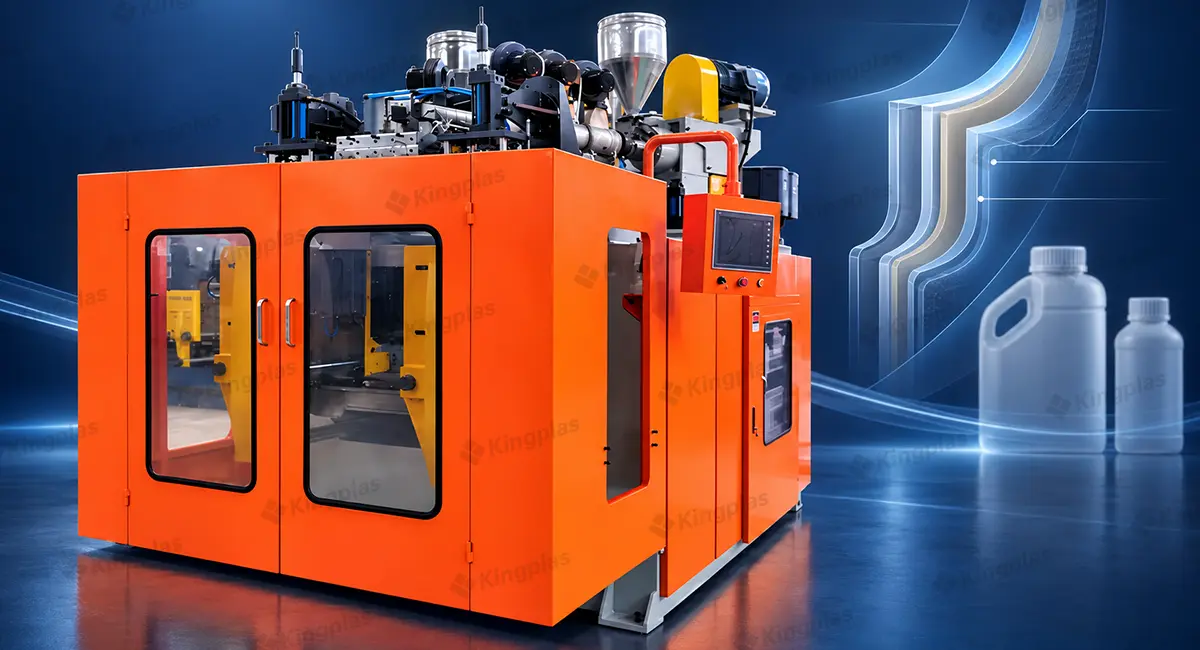
The outer and inner layers usually provide mechanical strength and process stability. Meanwhile, the barrier layer protects the contents. An adhesive layer may help incompatible materials bond together. The actual structure depends on the packaged chemical and its storage conditions.
When customers send us a sample or bottle drawing, we first review the wall structure and resin specification. We also check the neck, handle, corners, and parting line. These areas often require different material distribution from the flat bottle panels.
Extrusion Stability Keeps The Layers Consistent:
Each extruder must deliver a stable melt flow. Temperature variation or irregular output can shift the layer ratio and create weak areas. Therefore, our technicians check screw speed, heating settings, material preparation, and die-head balance during commissioning.
Kingplas lists three machine configurations for this product category:
- HW50R-III: 50/30/30 mm screw diameters, 50/8/8 kg/h plasticizing capacity, 50 kN clamping force, and 1 L maximum product volume.
- HW60R-III: 60/35/35 mm screw diameters, 80/10/10 kg/h plasticizing capacity, 80 kN clamping force, and 2.5 L maximum product volume.
- HW70R-III: 70/40/40 mm screw diameters, 110 kg/h listed plasticizing capacity, 100 kN clamping force, and 3.5 L maximum product volume.
These figures provide a starting point, not a guaranteed production result. Resin grade, bottle weight, mold cooling, die-head configuration, and operating conditions also affect output.
Die Head Balance Controls Material Distribution:
The die head combines the melt streams before the parison leaves the machine. A stable flow path helps maintain the required layer sequence around the bottle. Kingplas offers single, double, and triple die-head configurations for different cavity and output requirements.
During trial production, we do not judge the process only by bottle appearance. We cut sample bottles and inspect the wall at several positions. In addition, we compare bottle weight, layer continuity, pinch-off quality, and dimensional stability. This practical check often reveals settings that an operator cannot identify from the control screen alone.

Process Checks Reduce Common Bottle Defects:
High-barrier production requires consistent materials and operating conditions. Operators should keep the resin feed clean, confirm the required drying procedure, and record stable temperature settings. They should also inspect the parison before changing several parameters at once.
Our field experience points to four useful checks:
- Confirm that every extruder supplies material at a stable rate.
- Check layer continuity at corners, shoulders, and pinch-off areas.
- Match cooling time to the bottle wall and mold design.
- Test the finished bottle for its actual filling and storage conditions.
However, multilayer construction cannot correct an unsuitable resin combination or an incomplete package test. Customers should validate chemical compatibility, drop performance, sealing, and storage life before mass production.
Machine Selection Starts With The Bottle:
A buyer should not select a high barrier bottle blow molding machine from volume alone. Bottle geometry, layer count, resin type, cavity quantity, wall distribution, and downstream trimming all influence the final configuration.
Kingplas designs and manufactures blow molding machines and molds for industrial packaging, consumer packaging, automotive parts, and technical products. Its extrusion blow molding machine range covers continuous extrusion, accumulator-head, and special multilayer applications.
Before recommending a model, the technical team needs a bottle sample or drawing, target weight, material structure, required output, factory voltage, air supply, and cooling-water conditions. This information helps identify practical limits early and prevents unnecessary machine capacity.
FAQ:
Q1: What products need a high barrier bottle blow molding machine?
A: Pesticide, agrochemical, solvent, and other sensitive-product bottles may need multilayer walls when a single resin cannot provide the required barrier performance.
Q2: Does a thicker bottle always provide better barrier performance?
A: No. Total thickness affects strength, but barrier performance also depends on material selection, layer continuity, and the position of each layer.
Q3: Can one machine handle different bottle sizes?
A: Yes, within the machine’s stated capacity and configuration. Each new bottle still requires a suitable mold, die-head setup, cooling conditions, and production trial.
Why Choose Kingplas Machinery?
Has 30 years blow molding experience. Our blow molding machine portfolio is designed to handle a wide range of thermoplastic materials, including HDPE, PP, PE, PVC, PC, and PETG, for containers ranging from 10ml to 1250L.
- Automatic Extrusion Blow Molding Machines: High-speed continuous extrusion systems (Single/Double Station) for cosmetics, lubricants, and household chemicals.
- Accumulator Head Blow Molding Machine: Robust solutions for large-scale industrial parts, such as 200L drums, IBC tanks, and automotive components.
- Multi-Layer Co-Extrusion Technology: Advanced 2-to-6 layer systems that provide superior barrier properties for agrochemical and fuel tank applications.
- Turnkey Solutions: Integrated production lines including precision mold design and auxiliary equipment.
Contact KingPlas:
Email: [email protected]
Tel/Whatsapp: +86 13862001031


